Picture
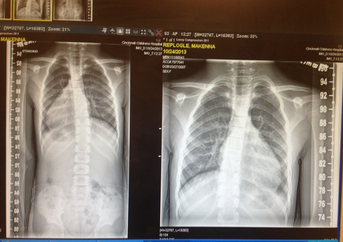
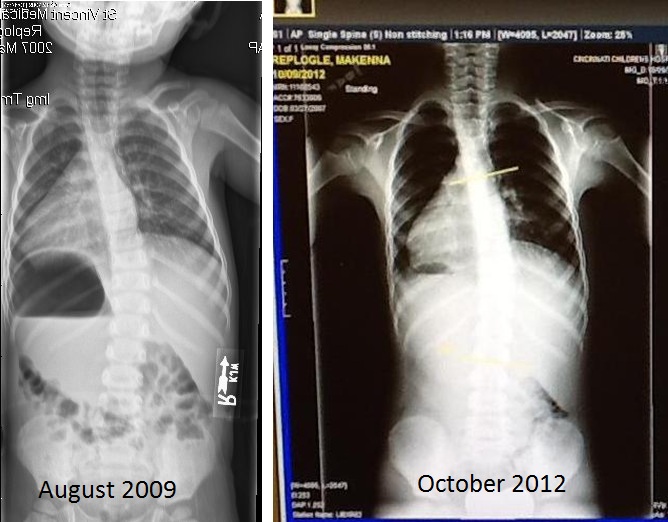
The image on the left is Makenna's initial x-ray in August of 2009. The image on the right is from October of 2012.
We had a follow up appointment in Cincinnati on Tuesday. We weren’t scheduled to go until November, but I felt Makenna’s brace was getting too small and we just couldn’t wait. I’m very glad we pushed it up!

This has been a long, continuous journey that has never gotten predictable! 

In the beginning – Fall 2009 – Makenna’s curve measured 20 degrees. This is a VERY small curve. Borderline for treatment, actually. However, considering more than the COBB angle, the doctor felt there were two reasons we needed to act swiftly and begin casting. First, the underlying genetic condition of Horizontal GazePalsy with PROGRESSIVE SCOLISOSIS sent a red flag to take notice. Second, her RVAD reading was high. RVAD is a secondary reading on an x-ray in early onset scoliosis that can be used to predict the likelihood of progression. An RVAD of greater than 20 degrees has an 84% chance of progressing. Makenna’s was 39 degrees.  

Makenna began casting in November of 2009. In each cast, she was perfectly straight. After a series of 4 casts she transitioned to bracing in October of 2010. She maintained straight in brace through our appointment in May of 2011. I felt like we had beat the beast! 

Then in July of 2011, she measured 13 degrees. A small slip. Not much to be concerned about (from the doctors side!). We continued with bracing – even lowering the amount of time she spent each day in brace. By November of 2011, she was till measuring 13 degrees and we were only bracing at night. She was still 13 degrees at our last visit in March 2012. 

Tuesday (October 2012), she measured 22 degreesL 

When I saw the x-ray, my heart sank. It looked familiar…but not normal. And then I saw the little yellow lines marking her vertebrae – with a seemingly innocent calculation of the curve… 22 degrees. 22 degrees is manageable. 22 degrees won’t interfere with normal function. 22 degrees is a milestone for some and a goal for others. Many, many of my dear friends with children on this up and down journey would be overjoyed to hear 22 degrees. So there is a large part of me that wondered why in the world this brought tears to my eyes. But the other part of me simple couldn’t help it.

 The only math my head was calculating was that there was an average progression of 10 degrees each year. 

We simply can’t continue that trend…

I could spend a lot of time trying to figure out how her curve crept back up. Didwe wait too long to go back? Should we have pushed for a new brace in March? In the long run, it really doesn’t matter how we got where we are. It just matters what we are going to do from here.

Her doctor is, of course, concerned. But let’s be realistic…if a five year old
walked in off the street with a 22 degree curve, most doctors wouldn’t do
anything. Like I said earlier, if she comes out of this as an adult with a 22
degree curve, there won’t be any effect. She won’t even notice. When I first
found her curve no one believed me. You can’t see it (well, I can…) and it
doesn’t interfere with her daily functioning or her vital organs. Even if it got
to 30 or 40… still wouldn’t matter. She could function…probably wouldn’t even need surgery or have any pain. 

That was actually the hardest part of the visit - when her doctor outlined the normal treatment for someone Makenna’s age with her curve (even knowing the underlying condition). Brace. Hopefully contain/maintain. Carefully watch. If it progresses to 30 or above then we adjust the time in brace. We don’t know what the curve is going to do. It could stay right here. It might get a little worse. It could take off and we could lose control of it– then we’d talk surgical intervention. That’s the pragmatic view from the doctor side.

Wait… What?! Why am I having this conversation? We did everything
right…  We caught it early. We got proper treatment right away. We diligently researched to find the underlying cause to pass the information on to the doctors who care for her. Why is surgery back on the table? Why? And I know realistically it’s not really back on the table at 22 degrees. But the very fact that he mentioned it… just sticks in myhead.

From the mom side… I just want it to go away. I want to fix it. My goal is zero. I am a control freak. I want a logical answer and hard statistics. I believe in “if X, then Y”. Unfortunately, scoliosis doesn’t work that way. There is no charted path. No statistics to predict what may happen with any given curve. NO control. NO set outcome. SUCKS!

Throw into the mix that Makenna has HGPPS and it’s all just a shot in the dark. I just have to keep faith that there is a gift here, somewhere. And that it will all work out however it is supposed to. I have to let go…and let
God.

 So, the plan for now is this. We molded for a new brace. It will have pressure padding and will be higher on her left side with a hole on her right. I am hopeful it will provide some correction.

 Friends have asked me if they will re-cast her.  The answer is “NO”. Not for her. The genius of casting is found in harnessing the rapid growth of the spine in the first two years of life. When the growth is not as rapid, most research indicates that the same correction (or hold) can be achieved by bracing. I know lots of kids still being casted who are older than Makenna. Their circumstances and curve are completely different than hers. Casting is the smart option for them, but not for Makenna. This is hard to hear as a parent because I have been indoctrinated to believe that bracing is for the birds and will only hold the curve. Bracing has come a long way. Hospitals that regularly do casting have orthotist in the OR during the procedures. These orthotists are seeing the results and appreciating the corrective ability of carefully ‘realigning” the body while molding. They understand the goal is to gain correction rather than simply hold the curve. An orthotist with this experience and goal is who will be making Makenna's brace.

I feel at peace with where we are and what we are doing. It was a rough week, but in the end, I know it will all be ok. I’ve done a lot of research this week and reached out to a lot of old contacts. It’s funny to phrase it that way. I’ve emailed lots of people that I’ve emailed in the past who have been kind enough to answer me before – that’s more to the point. Doctors and researchers who are studying HGPPS, or Vertebral Stapling, or the underlying causes of scoliosis. I've got some replies already, which speaks volumes to the importance of asking questions and the generosity of people invested in helping kids and families. I’ve also got some innovative suspension therapy lined up and have been thinking of things we can do to help even here at home. I told you… I’m a control freak:)

 As Makenna has come “full circle” with her curve, I, too,  have come full circle with the lessons I’ve learned. 

You can’t plan everything. 

You have to remain open-minded and flexible. 

Sometimes, things just don’t go your way. 

You have to find a way to find the positive in every situation.

You will never be handed a challenge you can’t meet.  It may require asking for help, but you will meet the challenge :)


All of these are important lessons. Hard to learn, but valuable to know.

We are blessed.


Picture
On our walk the other day, the girls were picking dandelions and blowing the fuzz off. Makenna asks Abby if she's supposed to make a wish when she blows it all away. "Sure", Abby says, "I did. And I think it will come true because it was reasonable".

"That's right", I reminded them. "You shouldn't wish for a unicorn or somethings crazy like that... because it probably won't come true, then you'll be disappointed."

"Darn it!", Makenna says, laughing as her fuzz goes flying away. "My wish will never come true."

"Uh-oh. What did you wish for Makenna?"

"For life to be fair."

hahaha:)


Picture

It's been a really long time since my last post. And I didn't even do a good job of finishing Scoliosis Awareness Month!
We've been really busy ~ and so has my e-mail... more on that in future posts :)


Makenna just started kindergarten. She loves every day! I am so grateful for the smooth tranisition for her. 

While starting school is exciting, all that paperwork comes with a whole new set of questions.

"Please list all medical conditions". 
    Really? Can I send in some research articles to go with that? Is it helpful for you to know ~ without actually knowing what it is? 

    I know this things are important for educators to be aware of. Trust me ~ I know from first hand experience. I once taught a student for 6 months before I was aware she had spina bifida (wasn't in the paperwork). She was three when I first got her in class. Each week, something would concern me about her motor planning. It was borderline normal for 3, but over time it just didn't sit right. After double checking her birth date and realzing she was almost 4 ~ I approached mom. I explained that I was concerned with her motor planning and thought she should run it by her pediatrician and see if he/she thought it might warrant further investigation. "Well, she has spina bifida. So her coordination is going to be a little off. That's why she's here." :) Hmmm...that would have been helpful to know.

    So I know that the information is pertinent, I just don't know in what detail I should present it. How much information does the teacher need? How much will she use? How much is too much? Will it effect how she is treated in the classroom?

    All of these questions make me understand why some parents are reluctant to lay out their child's potential weaknesses. I never understood this before Makenna. The fear is that the teacher will only teach to the expectation set forth. "Well, if she can't track... she'll probably be a bad reader." etc... And these are natural human thought and conclusions ~ so I would never fault anyone for having them. 

    But, I have been adamant about the fact that I will not handicap Makenna before she needs it. I will simply be prepared to respond if she shows signs of difficulty. Even though Makenna's vision is good - minus that pesky tracking thing, I have had in depth conversations with vision specialist on how to help children read who have trouble seeing. I haven't employed a single strategy they gave me ~ because Makenna hasn't shown signs that she needs them.  
     
    I'm not going to assume she needs the help... but I'm going to be prepared if she does.

    It's a brave new world. Makenna is meeting it head on. Just this morning, Abby felt as if Makenna was making fun of her for being a 'scardy cat' because of an incidence last week where she freaked out when the lights went out. I tried to explain to Abby that Makenna wasn't on purpose making fun of her and couldn't possible string those things together over a weeks time. I emphasized that it was Abby's perception of Makenna's comments because she was sensitive to her comments because of  "the event".

    In her five year old wisdom, Makenna reminded us all, "That's right Abby. I see things the way I see them, and you see things the way you see them. That's because we have a different reality."

    Once again ~ Thank you, Makenna, for putting it all in perspective and teaching me a thing or two:) Love that kid! At least I don't have to worry that she's not very clever!


Jackson story is here. Jackson and his family are an amazing source of strength and hope for many families on this journey!
 
 
Sebas is treated at Cincinnati Children's Hospital by Dr. Peter Sturm.
 
 
Sweet, sweet Kailtyn has been through more in her short life than many of us will endure over the course of ours. And she smiles through it all. Her story is truly one of perserverance, patience and faith. Any day now Kaitlyn will welcome a new baby sister!!!!
I am inspired by her family's strength and faith. You can read her story here.
 
 
Today's story belongs to Ian. On this day, Ian will also be recieving his very first cast to help correct his scoliosis.
 
 
Today's story is close to my heart. Grace has the same underlying condition as Makenna - HGPPS. I
See Grace's story here.
 
 
The
majority of scoliosis cases (80-85%) are idiopathic, meaning there is no known
cause. There is much ongoing reserach to determine the cause(s) of
scoliosis.
The following abstract outlines my favorite theory:)


Evidence for cognitive vestibular integration impairment in idiopathic scoliosis patients (2009)

Simoneau Martin,Lamothe Vincent,Hutin Émilie,Mercier
Pierre,Teasdale Normand,Blouin Jean

Abstract
Background: Adolescent idiopathic scoliosis is characterized by a three-dimensional deviation of the vertebral column and its etiopathogenesis is unknown. Various factors cause idiopathic scoliosis, and among these a prominent role has been attributed to the vestibular system. While the deficits in sensorimotor transformations havebeen documented in idiopathic scoliosis patients, little attention has been devoted to their capacity to integrate vestibular information for cognitive processing for space perception. Seated idiopathic scoliosis patients and control subjects experienced rotations of different directions and amplitudes in
the dark and produced saccades that would reproduce their perceived spatial
characteristics of the rotations (vestibular condition). We also controlled for
possible alteration of the oculomotor and vestibular systems by measuring the subject's accuracy in producing saccades towards memorized peripheral targets in absence of body rotation and the gain of their vestibulo-ocular reflex.

Results: Compared to healthy controls, the idiopathic scoliosis patients
underestimated the amplitude of their rotations. Moreover, the results revealed that idiopathic scoliosis patients produced accurate saccades to memorized peripheral targets in absence of body rotation and that their vestibulo-ocular reflex gain did not differ from that of control participants.
Conclusion: Overall, results of the present study demonstrate that idiopathic scoliosis patients have an alteration in cognitive integration of vestibular signals. It is possible that severe spine deformity developed partly due to impaired vestibular information travelling from the cerebellum to the vestibular cortical network or alteration in the cortical mechanisms processing the vestibular signals.


Picture
June is National Scoliosis Awareness Month. I'll be updated the blog more often this month, with a goal of doing it every day:)

Being aware and being educated is the best way to help your own children and those around you.

My goal is to post a link to more information each day, along with a small fact about scoliosis. I will also post a link to a story of a child with scoliosis. My dear friend Catie has a blog at ChicagoNow.com called Suck It, Scoliosis. She will feature a different story each day.

I am so blessed to have found so many connections on what could have been a very lonely journey.  The statistics show that infantile scoliosis, or Early Onset Scoliosis (EOS) is extremely rare.
Only 1% of all scoliosis cases develop in the first 3 years of life. Of that small percentage 90% of those cases will self resolve and require no treatment. 
We are the 10% - - - of the 1%!!.
I know easily 50-60 families with children who have progressive infantile scoliosis. Crazy. Thank you, Google:) and Facebook!

Today's story is about Addyson:)